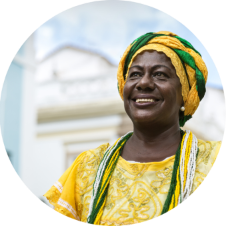
| Across Africa, women of faith are not waiting for permission. They are building the continent’s moral and social infrastructure, often without recognition, almost always without adequate resources. In June 2024, faith leaders from thirteen African countries gathered in Addis Ababa to confront a decree that had elevated female genital mutilation to an obligatory practice. Their response was theological, not legal. Thirteen countries. One collective voice. A declaration issued from within the traditions themselves. That is a form of moral authority no external institution can replicate. The leadership is effective and demonstrably so. The question is whether institutions will resource what already works. |
The theme of this year’s International Women’s Day and the Commission on the Status of Women is a sequence, not a slogan: Rights. Justice. Action. For ALL Women and Girls.
Rights come first because without them, nothing else holds. Justice follows because rights without enforcement are meaningless. Action is the output. The word “ALL” is the demand that authenticates the sequence as honest.
Across Africa, women of faith are not waiting for either permission or institutional frameworks to catch up. They are building the continent’s moral and social infrastructure. They are not petitioning the margins. They are operating as architects of community stability, policy change, and social cohesion. , often without the recognition or adequate resources they deserve, they are the African Women of Faith and are among the continent’s most strategically underestimated leaders.
Their work draws a conviction shared by different faiths, common action. Across our faith traditions that every person is created with inherent dignity, that the body is sacred, and that communities flourish when every member is protected, educated, and free to thrive into the fullness of their God-given purpose. This isn’t an ideology. It is a lived moral architecture, and when the women of faith exercise it with courage, it becomes one of the most powerful instruments for rights, dignity, justice, and actions that any community can have.
Rights in Action
Harmful social norms are not abstract; they are reinforced daily within households, religious gatherings, and school environments. These norms influence critical aspects of girls’ lives, including whether they can attend school, have a voice in shaping their own future, and exercise autonomy over their bodies. Women of faith are often uniquely positioned to challenge these norms from within their communities. As respected moral voices and trusted insiders, they continue to play a vital role in catalyzing transformation and promoting more just and inclusive social attitudes.
At a regional and national scale, women of faith across the continent have built enduring platforms for legislative participation and reforms. Serving national assemblies and regional bodies and establishing institutional infrastructure for not only women’s rights but for human dignity. Such infrastructure is rare and actively opposed. The legacy of women who stood against unjust governance, enduring house arrests, exile, and erasure-shaped the post-transition landscape and continues to anchor domestic violence response and gender justice frameworks decades later.
In Southern Africa, women of faith leaders have been working through the national interfaith structure, engaging governments directly on policy and producing legislative outcomes. No protest march. No court battle. A structured interfaith dialogue led with legal precision and moral clarity, with a seat at the decision-making table, and produced a rights outcome that the state had failed to deliver on its own.
When women of faith are at the table, rights become policy. Where they are absent rights remain aspirational.
Dignity as a Foundation
Before rights can be claimed, dignity must be recognized. Before justice can be sought. The person seeking it must be seen as worth it. Dignity is not categorized as a legal tenet. It is a theological one. And it’s the foundation upon which women of faith across Africa have built their most consequential work.
Every major faith tradition represented in the Africa Women of Faith network holds this in common. In June 2024, Women of faith leaders from 13 African countries gathered in Addis Ababa under the umbrella of Africa Women of Faith Network. Together they confronted a specific and urgent test of that conviction: A decree that had elevated Female genital mutilation: from a recommended practice to an obligatory one. Their response was grounded entirely in theology. Thirteen countries. One collective voice. Signed as a commitment.
That declaration was not issued from a human rights office or a development agency; it emanated from women who are within the interfaith communities. That is a form of moral authority that no external institution can replicate. It is also a form of authority that remains chronically under-resourced and underrecognized in global frameworks for women’s rights and protection. The question they raise is not whether practice is modern or traditional. It is whether it is consistent with the dignity that their God ascribes to every daughter. When that question is asked honestly, from inside the tradition, the response transforms the community.
Justice Requires Presence, Not Just Principle.
Justice does not happen in abstraction. It requires someone in the room when decisions are made and someone in the field when those decisions fail.
In West Africa, women of faith have served as the first female leaders of national interreligious councils, positioning themselves at the center of electoral mediation, bringing together Christian and Muslim leaders to manage political tension and prevent post-election violence. They didn’t wait to be invited into the peace process. They convened it.
In Central and East Africa, women of faith work as insider reconcilers in communities fractured by years of civil conflict, using trauma healing and interfaith dialogue to restore the relational bonds that the communities they have walked through personally. That evidence has reached international peace forums and shaped how reconciliation is understood at policy levels.
In southern Africa, women of faith leaders have lived through apartheid and it’s aftermath and built governance participation into foundations of new democratic institutions, and they continued to build twenty-four-hour domestic violence support infrastructure and gender justice programs that have superseded any political movement.
These are not individual success stories. They are data points in a pattern. Women of faith, when given access and when they create access themselves, produce justice outcomes. Electoral stability, policy reform reconciliation, infrastructure in governance, and participation across regions across decades. The pattern is consistent and cross-border.
Action at Gender-Peace-Climate Nexus
The gender-peace-climate nexus is not an academic language. It describes observable realities. Climate shocks intensify resource scarcity. Resource scarcity intensifies domestic strain and community fragmentation. Social fragmentation increases gender-based violence. Faith communities are often the first institutional presence when these pressures converge. Women of faith are frequently the first responders within those communities.
In Central Africa, women faith leaders work at the intersection of tropical forest protection and gender-based violence advocacy. They have simultaneously pushed for reforms in theological education so that the next generation of religious leaders carries gender justice as a core formation value, not an afterthought. In East Africa, women of faith have built multisectoral youth rehabilitation campaigns through interfaith networks and grassroots trust- reaching thousands of young people with counseling and training and pathways out of gang involvement and violent extremism. They have done this through persistent engagement with government structures and have been recognized at international peacebuilding forums for demonstrations of the connection between environmental security and social cohesion and gender leadership.
In West and Central Africa, women of faith leaders have engaged global environmental advocacy platforms, speaking for the rights of indigenous people and the protection of ecosystems that sustain entire communities. The work is not charitable. It is strategic. It recognizes that the health of the land and safety of women and girls are intertwined.
What Evidence Demands
The Africa Women of Faith Network, established in 2003 under ACRL-RfP, has built a continental platform spanning Christian, Muslim, Hindu, Sikh, and Bahá’í communities. The women profiled in this piece represent twelve countries and multiple generations. Their combined experience spans legislative chambers, electoral mediation tables, human rights & dignity, climate advocacy platforms, grassroots rehabilitation programs, and international policy forums.
That is not a network of peripheral actors. That is an ecosystem of leadership that intersects every major development challenge Africa faces.
Rights without resourcing remain aspirational. Justice without structural integration into peace and climate frameworks remains incomplete. Action without sustained partnership between faith networks, governments, and multilateral bodies dissipates before it scales.
What is required now is specific. First, formal integration of Women of Faith Networks into national peace architectures, gender and protection programs, and climate adaptation strategies. Second, sustained and multi-year funding for faith-based women leaders who have demonstrated governance capacity. Third, recognition by donor institutions and multilateral bodies that religious social capital is strategic infrastructure, not supplementary programming.
The women documented here are not waiting to be discovered. They have been operating for decades. The leadership is effective and demonstrably so. The question is whether institutions will resource what already works or continue to build parallel structures that communities trust far less.
Rights. Justice. Action. For ALL women and girls. The women of the Africa Women of Faith Network are already living those words. The obligation now belongs to everyone else.